
The working-age population in Satakunta is declining, and work ability is weakening. As many as 23.5% of highly educated residents do not believe they will be able to continue working until retirement age. Why are highly educated people in Satakunta experiencing such high levels of strain?
Concerning trends can be observed in the wellbeing of the working-age population both in Satakunta and across Finland. According to Kela, more than half of all disability pensions are now granted due to mental and behavioural disorders. In recent years, this figure has been higher than the national average in Satakunta and has clearly increased.
Within the HyvoData project, a plan is being developed for a regional mental health programme for Satakunta. The same objective is also included in the Satakunta Regional Programme 2026–2029, where the aim of the mental health programme is to strengthen work ability and prevent mental health-related illnesses among residents of Satakunta.
To ensure that the mental health programme can effectively address the regional situation, it is necessary to identify the key mental health challenges in Satakunta and the factors influencing them.
The link between education and psychological strain
According to the Wellbeing Report of the Satakunta wellbeing services county, the level of education in the region is increasing, but the overall educational level remains lower than the national average. In national comparison, Satakunta ranks second lowest.
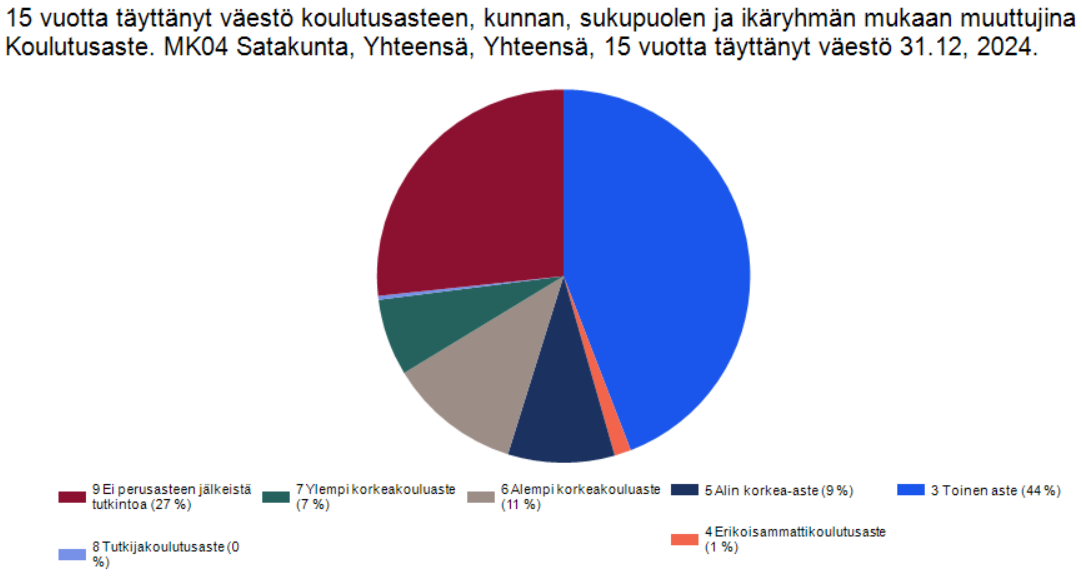
In Satakunta, 27% of the population have a low level of education and no qualification beyond basic education. Upper secondary general education has been completed by 45% of the population, while 27% have a higher education degree. Doctoral-level studies have been completed by 8% of the population. (Figure 1.)
The Wellbeing Report also shows that mental health problems have increased while positive mental health experiences have declined. The share of people experiencing significant psychological strain has increased particularly among the highly educated, while those with lower education levels report higher levels of psychological strain overall. Nationally, Satakunta has the lowest proportion of residents who perceive their quality of life as good. The share of 18–34-year-olds receiving disability pensions due to mental and behavioural disorders has risen to 2.5%.
The Wellbeing Report further reveals that 23.5% of highly educated residents in Satakunta do not believe they will be able to continue working until retirement age. Among those with lower education levels the corresponding figure is 32.2%, although the number has declined. Among those with a medium level of education the doubts have decreased most clearly; “only” about 14% do not believe they will be able to work until retirement age.
Occupational health psychologist: Cognitive strain common in expert work
Maria Niemi, Chief Occupational Health Psychologist at Medical Centre Karhulinna, is a member of the HyvoData project’s steering group. In her work she is part of a multidisciplinary occupational health care team and works with both individual employees and entire work communities. What is her perspective as an occupational health psychologist on why highly educated people in Satakunta experience psychological strain?
– Working life has become increasingly intense, and our brains’ information processing is under constant strain. The demand for learning new things, the flood of information, interruptions, and handling multiple tasks at the same time all create cognitive load. In addition, work spilling over into leisure time weakens our ability to recover, Niemi explains.
In Satakunta, 23.5% of highly educated people do not believe they will be able to continue working until retirement age. Niemi notes that strain in working life is not explained only by the amount of work but also by difficulties in detaching from work and uncertainty in the labour market. Psychological strain is particularly pronounced in expert and knowledge work, where the boundaries of work can easily become blurred.
– When we do not have enough time to detach from work, the risk of stress and burnout symptoms increases. Cognitive load is especially high in expert and knowledge work, which many highly educated people do. In addition, uncertain labour markets, expectations related to career development and role conflicts increase insecurity in working life. These factors may partly explain why highly educated people report more psychological strain, according to the Satakunta Wellbeing Report as well as many national research datasets. It should also be noted that recognising and reporting psychological strain may be more common in expert work, as the nature of the work places strain specifically on mental and cognitive processes, which are also what surveys tend to measure, Niemi reflects.
The Satakunta mental health programme
The HyvoData project has begun searching for solutions and building a regional mental health programme for Satakunta in cooperation with the Satakunta wellbeing services county. The programme work began with background analysis and mapping of the necessary data. The mental health programme plan will be developed over the next two years.
Niemi also reminds people of the individual’s ability to influence their own wellbeing. She encourages everyone to take breaks during busy workdays:
– At least one thing is clear: work and life should be slowed down a little, and recovery should take place throughout the day. Fortunately, each of us also has opportunities to influence this – so take a moment to sit down and breathe before starting the next task.
The HyvoData project is co-funded by the European Union.