
The Lissu All Stars peer mentor training was developed in workshops in Pori, Rauma and Säkylä. In total, 79 participants highlighted what kind of skills peers need, especially when supporting people who have experienced challenges with substance use.
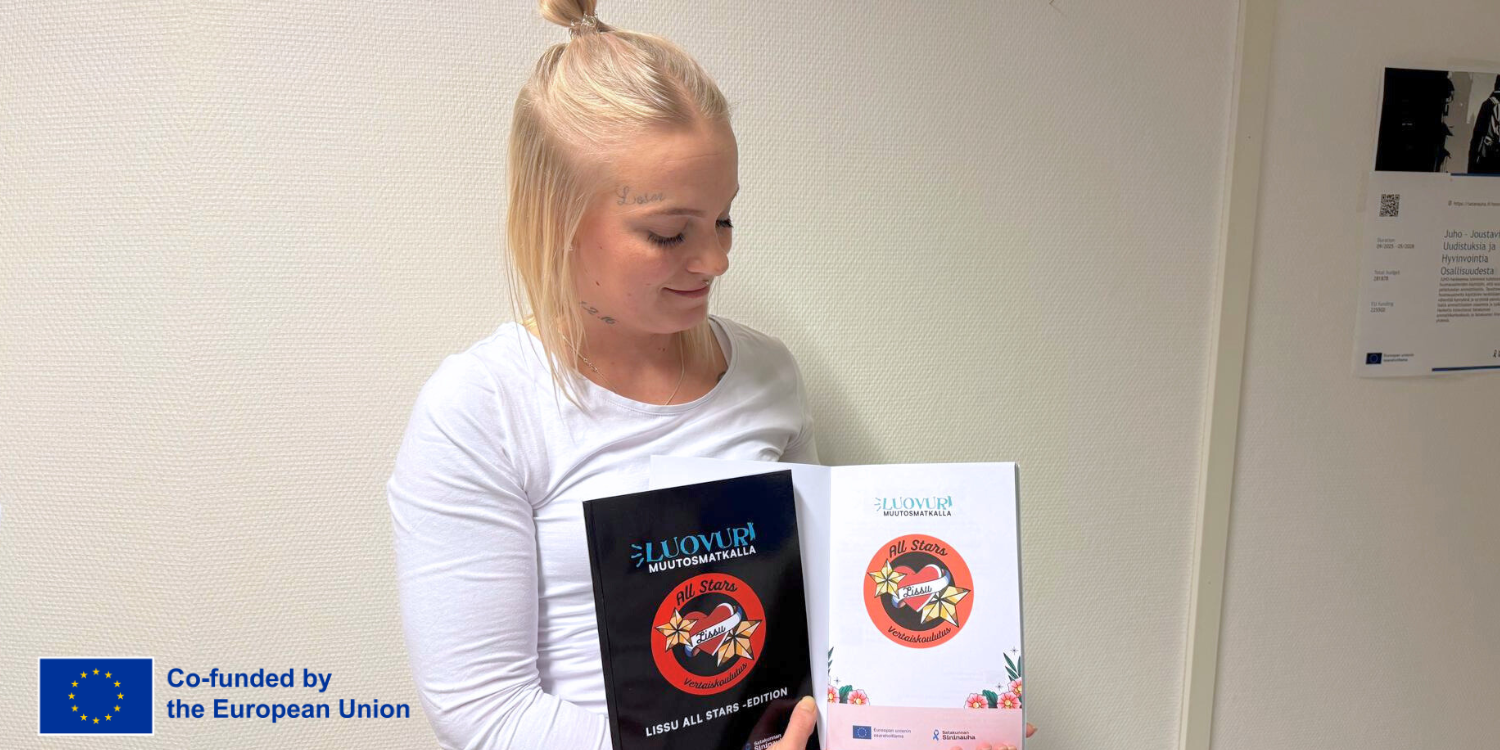
Satakunnan Sininauha ry and Satakunta University of Applied Sciences are organising the Lissu All Stars peer training as part of the project Flexible Reforms and Wellbeing through Inclusion (JUHO). The training was developed in Lissu Edit workshops, where content for the upcoming peer mentor training was co-created.
The workshops were designed for individuals interested in becoming peer mentors, as well as social and healthcare professionals. The goal was to gather insights into what a peer mentor training programme should include.
The peer mentor training provides both basic and advanced skills for acting as a peer mentor. No previous experience or expertise in peer mentoring is required. The training is free of charge and intended for individuals who have personal experience of challenges related to substance use and who wish to offer peer support. Those who complete the training will have the skills to act as peer mentors and to make plans for their own future.
The JUHO project team visited low-threshold meeting places in Pori, Säkylä and Rauma, where the Lissu All Stars peer mentor training will be held. During these visits, the Huittinen Hehku satellite location was found to be particularly well-suited for hosting workshops. The target group of the project was reached exceptionally well there; more participants attended than expected.
First aid skills and meeting family members identified as key themes
Each Lissu Edit workshop lasted approximately three hours and was organised three times in total. Altogether, 79 people participated in Pori, Rauma and Säkylä.

In the workshops, participants jointly developed ideas for the content of the Lissu All Stars peer mentor training. The aim was to ensure that the target group itself could influence the content and define what peer mentors should know or be able to do.
First aid skills emerged as one of the most important themes. Participants highlighted the need to know how to act in situations such as psychosis, poisoning, calling emergency services, withdrawal symptoms, and overdoses. The Finnish Red Cross will compile suitable training content to address these needs as part of the peer training programme.
Another key theme was how to encounter and support family members. Many participants emphasised the importance of being able to discuss a loved one’s substance use problem with a peer mentor. In this way, family members can receive understanding and perspective that may not be possible to obtain from their own loved one. The author also has personal experience of meeting family members who have needed to process their thoughts. Such conversations have helped relatives understand that certain behaviours are not personal, but rather consequences of substance dependence.
The Lissu Edit workshops consisted of three sections
First, participants planned the content of the Lissu All Stars peer mentor training through case examples. They were divided into groups and given example situations to discuss. Together, they considered how to act in these situations and how a peer mentor could provide help. The discussions were active and thoughtful, and the atmosphere was warm and supportive.
Second, participants discussed first aid skills based on a survey conducted by the Finnish Red Cross. These discussions will form the basis of a dedicated first aid component within the peer training. Topics included how to respond to poisoning, psychosis, wounds and other emergencies, how to lower the threshold for calling for help, and how to prevent or reduce drug-related deaths and other harmful situations.
Third, participants discussed how substance use could be addressed sensitively in services, so that asking and answering questions about it would not feel uncomfortable for either party. This theme is connected to a campaign being developed within the JUHO project to make it easier to ask about and disclose substance use in healthcare services. The topic generated many examples in each workshop and was considered highly important. Many participants shared experiences of feeling that questions about substance use are sometimes asked based on appearances, and that their answers may influence the help they receive. This can make it difficult to speak openly about one’s situation.
Summary of the identified competence needs for peer supporters:
- Based on the discussions and survey responses, reliability was seen as the most important quality of a peer mentor. A peer mentor must be someone others can rely on when their own wellbeing or functional capacity is insufficient.
- A peer mentor takes responsibility, understands clear boundaries, and acts safely and consistently within their role.
- Peer mentors can accompany individuals to appointments at public offices, health centres or social services when attending alone feels overwhelming.
- Many participants considered it important that a peer mentor can act as a voice for someone who no longer has the strength or ability to speak on their own behalf.
- Peer mentors could also play a significant role at health counselling points by sharing information, guiding people to services, and assisting, for example, in obtaining clean equipment.
- A peer mentor encourages, reassures and recognizes emergency situations. They know how to call for help and provide initial support when necessary.
- Experiential knowledge was strongly emphasized: a peer mentor can share personal experiences from similar situations and demonstrate that change and recovery are possible.
- Peer mentors should also understand which services to refer people to and when it is important to seek professional help.
- At the core is presence: a peer mentor walks alongside, supports, listens and helps without taking over, but without leaving anyone alone.
Across all workshops, participants strongly emphasized the need for the upcoming Lissu All Stars peer mentor training. Being able to participate, being asked for input, and being regarded as important created warmth, trust and a sense of belonging among peers.
The first Lissu All Stars peer mentor training will begin in Pori in March 2026. In the spring, training sessions will also be organised for social and healthcare professionals on substance dependence as a disease and the importance of respectful encounters.
The Flexible Reforms and Wellbeing through Inclusion (JUHO) project is co-funded by the European Union.