
As remote services have become more widespread, acute care work has also partially moved into digital environments. Evaluating and guiding care needs over the phone has become an increasingly central part of the everyday work for acute care staff. This work is demanding, yet very little has been done to develop the related skills and structures that support staff well-being. The FeelWork project addresses this challenge by developing and piloting a new training model that promotes acute care staff's competence and well-being at work.
At the heart of the project is the digital FeelWork training model, which aims to strengthen the ability of acute care staff to perform remote evaluation and guidance tasks. At the same time, the model introduces tools for managing work-related strain and supporting well-being at work. The training model is designed specifically for acute care professionals who evaluate care needs and provide guidance over the phone.
The project focuses on the types of resource and workload factors that staff recognize in their work and how these can be addressed through training. At the same time, the aim is to strengthen good practices for supporting well-being at work and to disseminate them widely.
The FeelWork project applies a service design approach and proceeds in three phases: understanding, conceptualization, and prototyping. The method is based on a well-known model created by IDEO, which emphasizes user-driven development and a culture of experimentation (Brown, 2009). The advantage of service design is that it allows users' needs and perspectives to be directly integrated into the development work, improving the final product's impact and applicability (Koskinen et al., 2011).
During the understanding phase of the project, information on the target group’s experiences and working conditions was gathered through interviews and a literature review. The aim was to identify the physical and psychosocial risks as well as the work resources. This phase was carried out in the autumn of 2024.
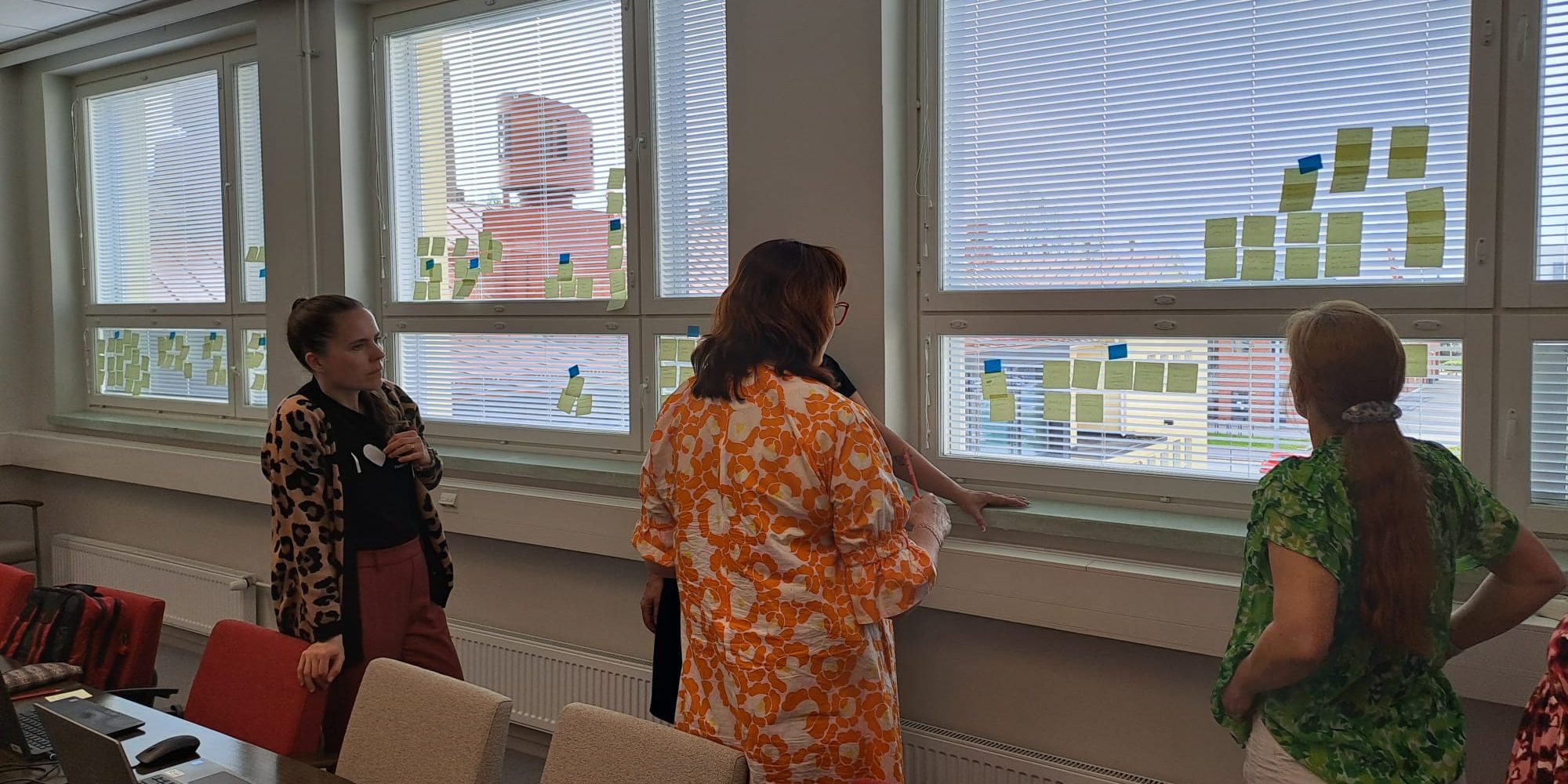
The next step, conceptualization, included a survey conducted among the target group to map out the staff's experiences of work-related strain factors and development needs more broadly. The survey was completed in spring 2025. Based on the results, workshops will be organized in the autumn of 2025, where acute care staff will brainstorm ideas for the content and methods of the training model.
In the prototyping phase, which will take place after the workshops, the project team will compile the training model and its digital content. The target group will then pilot this training model in their work for three months. Feedback from the target group will be used to finalize the model. The model will be ready by the end of 2026 and published on the Opin.fi service for everyone to access.
The objective is to make the FeelWork training model openly available and usable nationwide in both wellbeing service counties and educational organizations in the field. The model provides concrete tools for managing work-related strain and developing professional competence, especially in situations where care needs are evaluated remotely without direct patient contact.
The training model can be used to increase employees' ability to assess their own well-being, utilize their own resources, and support the continuous development of their professional competence. At the same time, the model promotes smooth workflows and client-centred care. Remote work poses specific challenges for managing work-related strain; in nursing, these challenges are cognitive, emotional, and technological.
Did you know?
- Nursing staff who perform remote evaluations simultaneously face cognitive, emotional, and technological demands.
- Service design is ideal for developing training models, especially when many practicing professionals are involved.
- The digital training model is designed for easy implementation, even without an external trainer.
Authors:
Anu Elo, Master of Health Sciences, RN (Master´s degree), Senior Lecturer, SAMK (Satakunta University of Applied Sciences)
Maarit Hallia, Public Health Nurse (Master’s degree), AmO, SAMK (Satakunta University of Applied Sciences)
Tuuli Paija, Master of Health Sciences, Senior Lecturer, Turku University of Applied Sciences
Nina Korsström, Master of Health Sciences, Senior Lecturer, Turku University of Applied Sciences
Sanna Saikkonen, Master of Health Sciences, Senior Lecturer, Vaasa University of Applied Sciences
Virpi Välimaa, Master of Health Sciences, Senior Lecturer, Vaasa University of Applied Sciences
The FeelWork project is a group initiative co-funded by the European Social Fund Plus (ESF+) with Turku University of Applied Sciences as the main coordinator. The sub-projects are implemented by Satakunta University of Applied Sciences Ltd and Vaasa University of Applied Sciences Ltd. The project will run from September 1, 2024, to December 31, 2026.


References
Brown, T. (2009). Change by design: How design thinking creates new alternatives for business and society. Harvard Business Press.
Koskinen, I., Zimmerman, J., Binder, T., Redström, J., & Wensveen, S. (2011). Design research through practice: From the lab, field, and showroom. Morgan Kaufmann.